
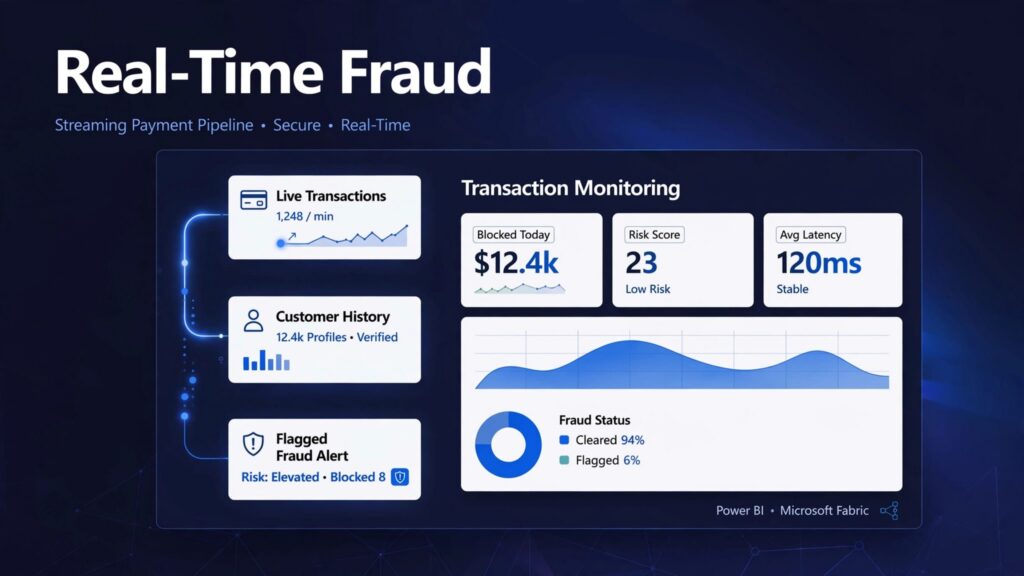
An overnight fraud alert can arrive after the payment has already settled. Effective transaction monitoring combines fast fraud detection with customer context, reliable data, and a clear response process.
Microsoft Fabric can connect streaming transactions, historical records, and operational reporting. However, stopping a payment also requires integration with the system that authorizes it. Start by separating the controls that need immediate action from those that need deeper investigation.
Key Takeaways
- Combine real-time fraud detection with historical AML analysis rather than replacing one with the other.
- Use Fabric to connect transaction streams, customer context, risk analytics, and reporting.
- Measure success through detection quality, response time, analyst workload, and operating cost, not dashboard speed alone.
What Transaction Monitoring Covers
Transaction monitoring continuously analyzes financial transactions to detect, report, and manage potentially suspicious activity. It supports anti-money laundering (AML), terrorist financing detection, and fraud investigations.
UNODC’s money-laundering overview cites an estimated 2% to 5% of global GDP, approximately $800 billion to $2 trillion annually. These are broad estimates, not a measured total for 2026.
KYC establishes the customer baseline
Know your customer (KYC) identifies customers and establishes their expected activity and risk profile. Monitoring compares actual behavior against that baseline over time.
For example, a cash-intensive retailer needs different monitoring assumptions than a salaried individual. FinCEN’s customer due diligence requirements connect understanding customer relationships with ongoing monitoring and identifying suspicious transactions.
Screening checks parties and payments
Transaction screening checks payment details and counterparties against sanctions lists and other restrictions. Monitoring examines behavior across transactions, accounts, devices, and time periods.
The decision rule is straightforward: use KYC to understand the customer, screening to identify prohibited relationships, and monitoring to detect suspicious patterns. A payment that passes screening can still warrant investigation.
How Monitoring Works, Step by Step
A dependable transaction monitoring system connects detection with accountable action.
- Collect transactions and context. Bring together payment events, customer profiles, account histories, merchant details, and relevant device signals. Reconcile source totals so missing feeds don’t create invisible coverage gaps.
- Normalize and enrich records. Standardize currencies, timestamps, and transaction types. Deduplicate repeated events, then attach customer risk classifications and historical behavior.
- Evaluate rules and models. Apply velocity checks, behavioral comparisons, and validated fraud models. Use streaming signals to support anomaly detection. Preserve the rule version, model version, and evidence behind each score.
- Generate and route alerts. Prioritize cases by potential exposure and urgency. Route time-sensitive fraud signals to operational responders, while sending AML patterns to investigators.
- Investigate and document outcomes. Treat alerts as signals for review, not confirmation of fraud or suspicious activity. A human investigator reviews relevant evidence before resolving a case, records decisions, and escalates reportable activity. Feed confirmed outcomes back into rule tuning and model evaluation.
The response can be a notification, additional authentication, payment hold, or case creation. Each action needs an owner and an approved execution path.
Continuous operation also needs feed-health alerts, replay capability, and escalation coverage. A running dashboard doesn’t prove that every source is arriving or that someone will handle an urgent case overnight.
AML Rules and Fraud Signals Need Different Context
Rules become more useful when they reflect the customer, transaction channel, and business purpose. Use a risk-based approach to set thresholds. Amount-only rules rarely provide enough context and can generate false positives.
Detect structuring and connected movement
In the United States, reportable cash transactions exceeding $10,000 generally require a currency transaction report (CTR), subject to applicable exemptions. Aggregation rules can cover multiple transactions during a business day.
Structuring breaks larger amounts into smaller transactions to evade reporting requirements. Tune detection around aggregated cash activity, repeated patterns, customer expectations, and subsequent transfers.
Money laundering progresses through placement, layering, and integration. Layering is particularly difficult to detect because transfers can obscure connections between funds and their original source.
Combine velocity with behavioral evidence
Fraud analytics also examines account takeover, card testing, unusual devices, and rapid transfers. Corporate finance teams can correlate vendor bank-detail changes with payment activity to identify impersonation risks.
A rule flagging every deposit below $10,000 would produce excessive noise. Better tuning adds linked accounts, repeated deposits, and unexplained onward movement. Back-test changes against confirmed cases before deployment, measuring missed cases alongside reduced alert volume.
Batch Versus Real-Time Monitoring
Traditional AML monitoring often runs overnight. Real-time monitoring analyzes events as they arrive and can support intervention before funds move.
Different decisions justify different processing costs.
| Approach | Suitable decisions | Main trade-off |
|---|---|---|
| Batch | Historical patterns, retrospective investigations | Lower urgency, later detection |
| Real-time | Account takeover, payment velocity, urgent exceptions | More demanding latency and availability requirements |
| Hybrid | Immediate fraud controls plus longer-term AML analysis | Requires consistent data across both paths |
A hybrid transaction monitoring design uses streaming for urgent decisions and batch processing for broader history and investigation context.
Unit21 advertises transaction evaluation below 150 milliseconds. That vendor claim isn’t a latency guarantee for an entire Fabric architecture. Measure end-to-end response time across ingestion, enrichment, scoring, routing, and authorization-system response.
An alert generated after settlement can support investigation, but preventing loss requires a decision path connected to payment authorization.
Building the Fraud Analytics Layer in Microsoft Fabric
Fabric Real-Time Intelligence brings streaming analysis and operational visibility into the broader data platform. It complements payment controls and compliance case management.
Connect streaming events with governed history
Connected banking applications, ATM systems, and ecommerce platforms can publish events through Eventstream. Eventhouse supports KQL analysis, normalization, deduplication, and recent-activity aggregation. Event-time windows help evaluate activity as events arrive, while explicit handling accounts for late or duplicate events and surfaces anomaly signals.
Data Factory pipelines bring ERP and customer context into OneLake. Dataflows Gen2 supports repeatable data preparation outside the time-critical authorization path.
A Microsoft Fabric Lakehouse can retain detailed history, while a Microsoft Fabric Warehouse supports curated SQL reporting. Our real-time analytics implementation services connect these components around business response requirements.
Turn risk signals into operational action
Deployed machine learning models can produce transaction risk scores. Relationship analysis can reveal shared devices, payment methods, or beneficiaries across apparently separate accounts.
Real-Time Dashboards give analysts operational views by region, customer segment, or risk category. Activator can notify responders when approved thresholds are crossed, with alerts and supporting evidence routed to case management for human review. Risk scores and alerts can inform an approved payment-control path, but Fabric alone doesn’t guarantee that a payment will be stopped.
Microsoft Fabric Power BI integration supports executive reporting through governed Fabric semantic models. Power BI semantic model optimization helps teams compare exposure, alert backlogs, and outcomes without recurring Excel reconciliation. Teams should validate models and monitor false positives as part of ongoing operations.
Fabric performance optimization and capacity planning must account for concurrent ingestion, queries, transformations, and reporting. Workload testing should cover these demands before a prototype becomes a 24/7 service.
Reporting Deadlines and Governance Are Operational Requirements
The Bank Secrecy Act dates to 1970. The FATF’s mandate records its establishment in 1989 to coordinate international efforts against money laundering and terrorist financing.
For U.S. institutions subject to applicable SAR rules, the general filing deadline is 30 calendar days after initial detection of facts that may support filing. If no suspect is identified, the rules can allow an additional 30 days, with a 60-day outer limit.
FinCEN’s suspicious activity reporting FAQs clarify that an alert isn’t automatically the filing trigger. A suspicious activity report (SAR) decision requires documented investigation and accountable review. A CTR threshold doesn’t automatically establish suspicious activity.
A monitoring policy should define coverage, risk assessment, rule ownership, escalation, investigation standards, filing responsibilities, and change controls. Include access restrictions, retention requirements, and evidence preservation.
Our Microsoft Fabric governance guide connects platform ownership, security, and controlled change across migrations and live analytics workloads.
Customer Success: Viscofan Moves Beyond Static Reporting
Microsoft’s customer example describes how Viscofan, a food-casing manufacturer, used Eventstream, Eventhouse, and Real-Time Dashboards through its Beyond25 digitalization program. Before this change, teams relied on static reports to respond to critical business situations. The new architecture provided shop-floor operators and decision-makers with more timely operational information. Microsoft’s Real-Time Intelligence customer examples describe this approach.
The case shows a relevant pattern for analytics teams: connect incoming events with shared business context, then give timely information to people responsible for responding. It’s an operational analytics example, not a fraud-detection benchmark, and it makes no claim about fraud outcomes or metrics.
Fabric Delivery Built Around U.S. Business Needs
At Spargent Analytics, our Microsoft Fabric consulting services support U.S. mid-market and enterprise organizations through design, implementation, migration, optimization, and managed support.
Our U.S.-focused delivery model builds around U.S. business needs. Senior Microsoft Fabric specialists from Europe work alongside internal analytics teams or fill delivery gaps. Strong communication and an efficient European cost structure can support higher ROI and reduce reliance on hiring a fully staffed internal data team.
As a Microsoft Fabric implementation partner, we connect data engineering services, Fabric Data Factory consulting, OneLake architecture, and analytics modernization. Our specialists support timely, governed transaction monitoring data and address the full lifecycle, so ingestion, reporting, and support stay connected.
Microsoft Fabric migration should preserve monitoring coverage as workloads move. Power BI to Microsoft Fabric migration also requires report, security, and semantic-model testing. Our Synapse and Fabric comparison helps frame data platform modernization decisions.
After go-live, Microsoft Fabric managed services support workload health, capacity usage, pipeline reliability, and cost control. The business goal is faster insight and dependable operations from existing Microsoft investments.
Frequently Asked Questions
Is transaction monitoring legally required?
Banks and other covered financial institutions must identify and report suspicious activity under applicable AML rules. Requirements vary by institution, activity, and jurisdiction. Corporate fraud monitoring alone doesn’t establish regulatory compliance.
Why do systems generate false positives?
Common causes include incomplete customer context, duplicate events, overlapping rules, and thresholds that ignore normal behavior. Improve data quality and evaluate rule changes against investigation outcomes, not just alert counts.
Which outcomes should leadership measure?
Track detection-to-response time, confirmed-case yield, analyst backlog, feed completeness, customer friction, and operating cost. Compare these measures before and after implementation to assess operational improvement.
Can Microsoft Fabric block or decline a payment?
Fabric can analyze transactions and send alerts, but it can’t block or decline a payment on its own. Intervention requires an integration with the payment authorization system.
How should teams handle an after-hours alert?
Route urgent alerts to an on-call reviewer under a documented escalation process. A reviewed case may support a SAR filing decision, but an alert alone doesn’t determine whether one is required.
Build Monitoring Around the Response
Effective 24/7 transaction monitoring connects trustworthy data with timely action. Fabric can strengthen that connection through streaming analytics, governed history, and consistent reporting.
Start with one decision that needs faster intervention and define its complete response path. Book a Microsoft Fabric Discovery Call to review your current environment and identify the next implementation or modernization step.
