
In This Article
A sales dashboard can look polished and still be wrong. When ERP and CRM systems define customers, orders, revenue, or dates differently, teams spend more time debating numbers than acting on them.
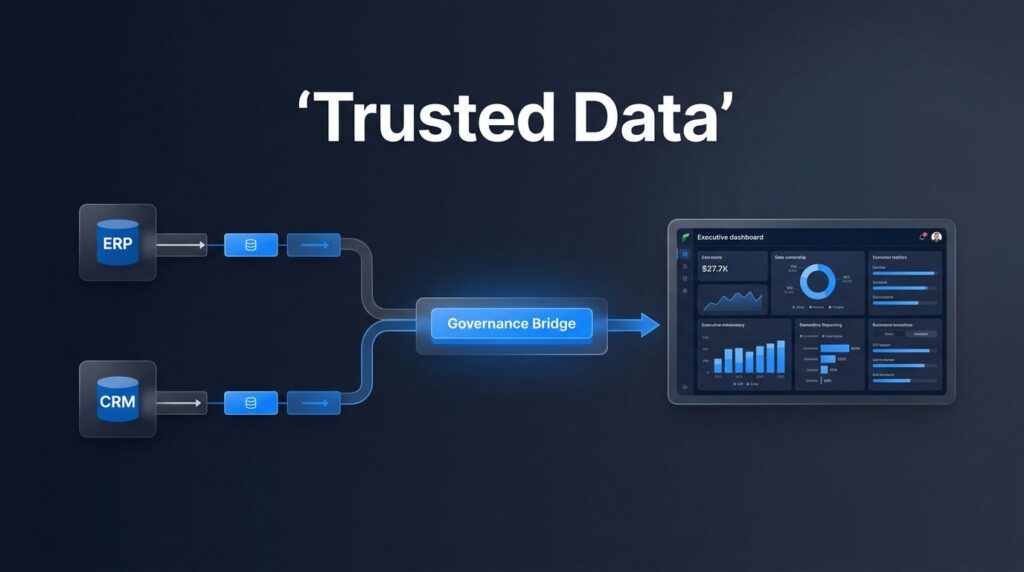
Data contracts set clear rules for the information moving between business systems, pipelines, and reports. By acting as a formal bridge between data producers, such as ERP and CRM owners, and data consumers in analytics teams, these agreements establish the necessary data quality standards for the entire organization. They provide finance, sales, operations, and analytics teams with a shared standard for what each field means, when it updates, and who owns it.
For companies building on Power BI and Microsoft Fabric, these data contracts turn reporting from a recurring cleanup exercise into a dependable business asset that ensures long-term data reliability.
Key Takeaways
- Data contracts formally document the meaning, structure, quality, ownership, and refresh expectations of ERP and CRM data.
- They prevent common reporting conflicts, such as inconsistent definitions of net sales, customer status, or order dates.
- By embedding standards within data pipelines, organizations can enforce strict data quality rules before information reaches critical business reports.
- Data contracts facilitate better communication between data producers and data consumers, ensuring that both sides align on expectations and requirements.
- Effective data governance, combined with robust data contracts, reduces the need for manual Excel reconciliation and eliminates reporting delays.
- Spargent Analytics helps U.S. organizations apply data contracts across Microsoft Fabric implementation, migration, optimization, and support.
Why ERP and CRM Reporting Breaks Down
ERP systems record financial and operational transactions, while CRM platforms track leads, accounts, opportunities, and customer interactions. These upstream systems were built for different jobs, yet they serve as the foundation for your organization’s analytics.
An ERP may treat a customer as a bill-to account, whereas a CRM might treat that same entity as a parent account with several contacts and opportunities. Finance often recognizes revenue at invoice posting, while sales teams track it at deal close. Without clear, shared rules, these inconsistent definitions cause data modeling to suffer, resulting in reports that produce several credible but conflicting answers.
These gaps become more expensive as reporting scales. Analysts frequently export CSV files, reconcile account IDs, create manual mappings, and rely on heavy data engineering to rebuild the same logic across multiple Power BI reports. The business loses trust because every refresh can change the story, especially when breaking changes in the source systems go unnoticed.
A data contract makes these rules explicit. By serving as machine-readable agreements, data contracts identify the system of record, approved field names, data types, allowed values, quality thresholds, refresh timing, security classification, and the accountable owner. They also define exactly what happens when a source system undergoes an update.
A reliable dashboard depends on more than correct calculations. It needs reliable inputs and agreed business definitions.
For example, a contract for Customer_ID might state that the ERP customer master is authoritative for active billing accounts, the field cannot be null, duplicates must remain below an agreed threshold, and the CRM account mapping refreshes every four hours. That guidance gives engineers a testable standard and provides report users a reason to trust the output.
Microsoft’s Power BI documentation is useful when planning how models, connections, and reports will consume those governed datasets. However, the data contract should be agreed upon by all stakeholders before analysts build any visuals.
What a Practical Data Contract Includes
A data contract should be concise enough that business owners can review it. At the same time, it must contain enough technical detail for engineers to validate it automatically. The strongest data contracts bring together business context and operational rules to ensure consistency across the enterprise.
| Contract element | Example for ERP and CRM data |
|---|---|
| Business definition | Net sales exclude tax, freight, and cancelled orders |
| Data owner | Finance owns net sales, Sales Operations owns opportunity stage |
| Source of record | ERP invoice table for recognized revenue |
| Schema definition | Invoice number is required, currency uses ISO codes |
| Validation rules | No duplicate invoice IDs, no future invoice dates |
| Freshness SLA | Daily by 7:00 a.m. local business time |
| Security rule | Customer contacts and payment details have restricted access |
| Change process | Source owner gives notice before renamed fields or logic changes |
The contract should also clarify grain. An invoice header is different from an invoice line, and a CRM opportunity can have several products and contacts. When a report joins these tables without a stated grain, it can double-count revenue or inflate pipeline values.
Business definitions deserve equal attention as you build your data products. Terms like booked revenue, invoiced revenue, and recognized revenue are not interchangeable, and the same applies to active customer, churned account, or qualified lead. These definitions should live within the semantic layer, where Fabric semantic models carry agreed calculations into measures, relationships, and report descriptions.
This approach supports Power BI semantic model optimization because analysts reuse approved calculations rather than writing competing DAX measures. By establishing a shared foundation for your metrics, you improve Microsoft Fabric Power BI integration and ensure high data quality, ultimately making your data contracts a vital asset for reliable reporting.
Enforcing Contracts in Microsoft Fabric
Documentation alone will not stop a bad source extract. Instead, teams should leverage automated enforcement within their data pipelines to reject, quarantine, or flag information that fails its requirements. Robust data observability is essential here, providing the visibility needed to monitor these checks and maintain data quality as it moves through the system.
A typical Fabric pattern starts with ingestion. Data pipelines pull ERP exports, SQL data, CRM APIs, or change data capture feeds into OneLake. Automated validation checks then confirm schema, row counts, keys, date ranges, and accepted values before refined data feeds your reporting layers. This proactive violation handling prevents downstream corruption and ensures that your data contracts remain reliable.
A Microsoft Fabric Lakehouse is often the right place for raw and refined data. The raw layer preserves source records for audit and troubleshooting, while the refined layer standardizes customer IDs, currencies, dates, and shared business rules. A Microsoft Fabric data warehouse can then support governed SQL reporting for finance and operations teams.
For teams modernizing Power BI, Dataflows Gen2 implementation can apply repeatable transformation logic close to the platform. Fabric Data Factory consulting helps establish templates for source onboarding, parameterization, error handling, and alerting. These repeatable patterns replace the bespoke scripts that often delay a new partner feed or CRM integration for weeks.
OneLake consulting is valuable when data already exists across Azure Data Lake Storage, Snowflake, Amazon S3, regional warehouses, or departmental systems. Shortcuts can provide access without creating unnecessary copies, although teams still need data contracts to define clear ownership, permissions, and source change protocols.
For operational use cases, contracts must address timeliness. A supply-chain report based on last night’s batch may be acceptable, but a fraud review or service-alert workflow may require real-time data within minutes. Fabric Eventstreams and KQL databases support real-time ingestion and analysis, but the fields, event order, retention period, and late-arriving data rules still require a formal agreement.
Data Governance Keeps Contracts Useful After Go-Live
A data contract fails when it exists only in a static document that no one checks. Robust data governance turns these contract requirements into everyday operating controls. By implementing a data mesh architecture, you can allow business domains to own their specific data assets, ensuring that those closest to the information maintain its integrity.
Start by assigning named owners. Finance should approve finance measures, while Sales Operations should own CRM stage definitions. Data engineering teams then own pipeline execution and technical quality checks. In this model, a central data team focuses on metadata management, setting company-wide standards while empowering domains to manage their own data products.
Microsoft Purview is essential for this framework, providing advanced data lineage, cataloging, sensitivity labels, and access controls. This is critical when ERP data includes supplier costs or payroll information, while CRM data contains sensitive contact details. Effective classification and policy-based access allow teams to share useful reporting without broadly exposing sensitive fields.
Change control is equally vital for maintaining data contracts. If a CRM administrator changes values like Closed Won, a pipeline may continue to run but report misleading conversion metrics. Contract owners must receive notice before any source changes. Furthermore, using CI/CD integration and version control ensures that contract files are managed alongside code, allowing teams to track changes systematically. Automated tests should identify renamed columns, unexpected values, and broken relationships before executives see a report.
This is where Microsoft Fabric governance and Microsoft Fabric managed services pay off. Ongoing monitoring catches refresh failures, capacity pressure, data quality drift, and adoption problems that project teams might otherwise miss after launch.
Microsoft Fabric performance optimization should follow real workload evidence. Large imports, Direct Lake models, DirectQuery reports, and real-time workloads consume capacity differently. Good Microsoft Fabric capacity planning measures peak refresh windows, report concurrency, model size, and business-critical service levels before users experience slow reports. When you integrate these practices, your data contracts remain resilient, accurate, and aligned with evolving business needs.
Migration Is the Right Time to Set Better Rules
Many organizations begin a Microsoft Fabric migration because they have too many Power BI datasets, copied files, and disconnected pipelines. A move alone will not solve inconsistent definitions. Instead, the migration plan should act as an opportunity to implement data contracts for each priority domain, ensuring you avoid accumulating technical debt during the transition.
During a Power BI to Microsoft Fabric migration, classify reports by business value, source quality, refresh need, and shared logic. Retire duplicate datasets. Then, rebuild priority reporting on certified semantic models with documented measures and controlled access. This process is also the perfect time to incorporate dbt for transformation logic within your architecture, supporting modern data engineering practices that ensure your reporting layer remains stable and scalable.
Companies that plan to migrate to Microsoft Fabric should start with one high-value reporting flow, such as order-to-cash, inventory, or sales pipeline. That creates a practical template for enforcing data contracts before expanding to other domains.
Spargent Analytics provides Microsoft Fabric consulting services for U.S. mid-market and enterprise organizations that need this discipline without hiring a complete internal platform team. As a Microsoft Fabric implementation partner, Spargent helps design ingestion, Data Factory pipelines, Dataflows Gen2, Lakehouse and Warehouse architecture, OneLake access, Power BI reporting, and governed semantic models.
Its Microsoft Fabric consultants support data platform modernization and analytics modernization across manufacturing, healthcare, finance, retail, energy, and education. Clients receive USA-market-ready delivery from senior European Microsoft Fabric engineers, with clear communication and an efficient cost structure compared with many USA-only consulting models.
A Microsoft Fabric expert can also help prioritize contract rules that will produce business value first. That may mean fixing customer master data before building executive reporting, or standardizing sales stages before creating forecast dashboards. For broader Microsoft Fabric analytics consulting, Microsoft Fabric data engineering services, and Microsoft Fabric consulting USA engagements, Spargent focuses on faster reporting, controlled cost, and stronger ownership.
When your platform is already live, Optimize Fabric Performance and Cost to review capacity, refresh patterns, semantic models, and reporting bottlenecks.
Make Contracts Part of Daily Data Delivery
The most useful contracts are versioned, visible, and tested during every pipeline run. They should sit alongside pipeline code, model documentation, and source-owner responsibilities. Think of these as a formal service level agreement that defines exactly what data is delivered and how it should perform.
Review these documents when a new source arrives, a business definition changes, or a report becomes widely used. Small updates are far easier than untangling a year of conflicting metrics. When you treat data contracts as a living part of your daily operations, you ensure that your reporting remains accurate and reliable.
For organizations that need a practical starting point, Book a Microsoft Fabric Discovery Call to assess ERP and CRM reporting, current architecture, governance gaps, and the next migration or optimization step.
Frequently Asked Questions
How do data contracts differ from standard data documentation?
While traditional documentation is often static and kept in separate wikis, data contracts are machine-readable agreements that define specific technical requirements and business rules. They allow for automated validation within your data pipelines to reject non-compliant data before it reaches your reports.
Can data contracts be enforced without a total system overhaul?
You do not need to rewrite your entire architecture to implement them. You can begin by applying contracts to a single high-value reporting flow, such as your order-to-cash or sales pipeline, and gradually expand the approach to other domains.
Who is responsible for maintaining the accuracy of these contracts?
Data contracts require a collaborative approach where business domain experts own the definitions and logic, while data engineering teams own the technical enforcement. This ensures that the people closest to the source data maintain its integrity while engineers ensure the platform remains reliable.
Conclusion
ERP and CRM reporting becomes dependable when teams establish clear standards before dashboards multiply. Data contracts provide the essential foundation for a scalable platform, ensuring that every field, calculation, refresh, and ownership decision is documented and agreed upon.
By prioritizing data reliability, data quality, and robust data governance through Fabric pipelines, governed OneLake data, trusted semantic models, and active monitoring, companies can finally move beyond manual spreadsheet reconciliation. The result is faster time to insight and a data architecture that supports daily business decisions instead of fueling internal arguments.
