
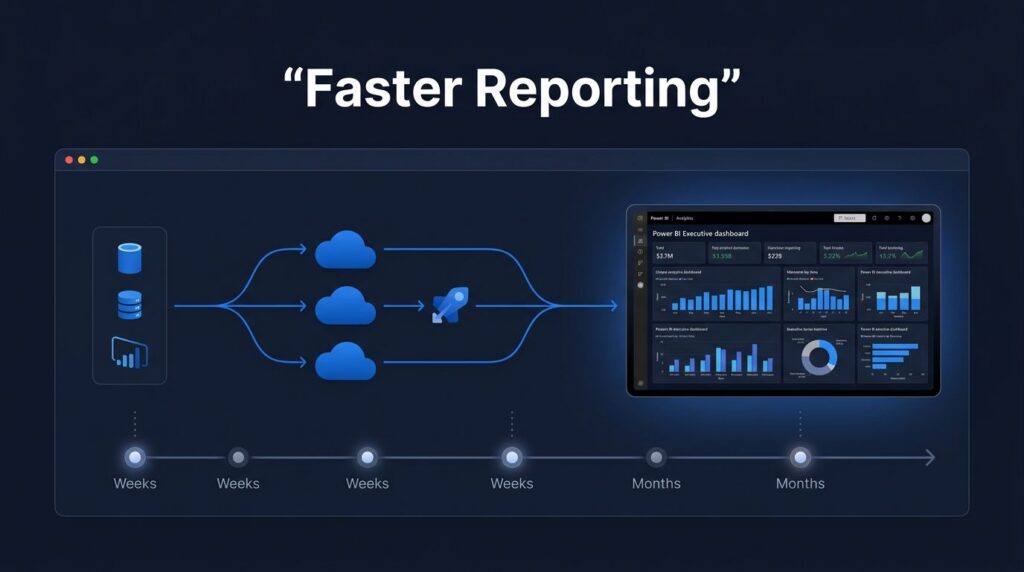
A focused Microsoft Fabric implementation can reach production in 4 to 8 weeks. During this window, the team focuses on architecture design and initial configuration to ensure the environment is ready for data ingestion. A governed rollout across several business domains often takes 3 to 6 months. Enterprise-wide modernization may continue for 8 to 12 months as teams migrate reporting, pipelines, and operating practices.
The difference comes down to scope, source-system quality, governance requirements, and available senior expertise. Because this is a SaaS platform, organizations often expect instant results. While a fast start is possible, a rushed foundation can create expensive rework later.
The practical goal is to deliver a valuable use case early while building a platform that can support the next one.
Key Takeaways
- A Proof of Concept for one Power BI reporting or operational use case often takes 4 to 6 weeks.
- Mid-market companies can commonly deliver a production pilot in 8 to 16 weeks with clear ownership and prepared source data.
- Larger Microsoft Fabric migration programs usually take 4 to 9 months, especially when they include several domains, legacy ETL, and formal Data Governance.
- Data quality, security design, semantic models, and capacity decisions affect timelines more than dashboard design.
- Spargent Analytics provides senior European delivery for U.S. organizations, combining strong communication and an efficient cost structure.
A Realistic Microsoft Fabric Implementation Timeline
The first question should not be, “How quickly can we turn Fabric on?” Microsoft Fabric is a SaaS platform, so setup is fast. The real work involves defining trusted metrics, connecting data, setting permissions, testing performance, and helping users change how they work.
A single-domain deployment, such as sales reporting or manufacturing operations, can move quickly. For example, a team may ingest ERP and CRM data using data pipelines, create a Microsoft Fabric OneLake and Lakehouse, build a Direct Lake model, and publish Power BI reporting in six to twelve weeks.
A broader data platform modernization effort aimed at creating a unified data platform takes longer. It may include legacy SSIS packages, Azure Synapse workspaces, spreadsheets, disconnected data marts, and multiple Power BI workspaces. Each dependency needs a migration path, validation plan, and owner.
| Implementation scope | Typical delivery range | What reaches production |
|---|---|---|
| Proof of concept | 4 to 6 weeks | One validated use case and core architecture |
| Single-domain pilot | 8 to 16 weeks | Pipelines, Lakehouse architecture, semantic model, reports |
| Multi-domain rollout | 4 to 6 months | Shared governance, Data Mesh strategy, data products, broader adoption |
| Enterprise modernization | 8 to 12 months | Scaled migration, operating model, support, and optimization |
These are planning ranges, not fixed promises. Microsoft also recommends treating adoption as an organizational program, not only a technical deployment. Its Fabric adoption roadmap covers strategy, governance, user enablement, and Center of Excellence practices that affect lasting adoption.

Fast delivery works best when the first release has a narrow business outcome, defined data owners, and measurable acceptance criteria.
The Four Phases That Set the Delivery Pace
A well-run implementation moves in short stages. This limits risk while giving business leaders evidence that the investment is working.
Weeks 1 and 2: Discovery, architecture, and priorities
The team inventories source systems, current reports, refresh failures, data owners, security rules, and business KPIs. This discovery phase includes a formal data maturity assessment to identify where your organization stands and which domain to prioritize based on value and feasibility.
This is where Microsoft Fabric capacity planning begins. Teams estimate storage, refresh patterns, Direct Lake usage, real-time workloads, and expected user demand before selecting or adjusting a Fabric capacity. Spargent’s Microsoft Fabric consulting services start with these practical decisions. A Microsoft Fabric expert can identify where existing Power BI models, Azure data services, and spreadsheet workflows should remain in place during the first release.
Weeks 3 through 6: Build the data foundation
Data engineers build data pipelines, establish workspace conventions, and create Bronze, Silver, and Gold data layers where appropriate. A Data Factory consulting engagement can speed up your design process, connection standards, error handling, and deployment practices. During this stage, your team can also begin exploring how Copilot and Data Science workloads can enhance your analytics.
The right storage choice also matters. A Microsoft Fabric Lakehouse is ideal for Spark-based Data Engineering and open Delta tables, while a Microsoft Fabric Data Warehouse fits SQL-centered analytics teams and governed reporting workloads. Effective OneLake consulting prevents unnecessary data copies while setting clear domain ownership across your OneLake environment. For Excel-heavy environments, Dataflows Gen2 implementation can standardize repeatable transformations, often reducing manual reporting effort within the first release.
Weeks 7 through 10: Analytics, security, and validation
Next, teams create semantic models, measures, row-level security, and reports that match agreed business definitions. Strong Power BI integration gives users a familiar reporting experience while data teams manage a stronger foundation underneath.
Testing should include refresh duration, query response, reconciliation against legacy reports, and permission checks. Semantic models optimization is especially important when users report slow visuals, inconsistent totals, or models with too many calculated columns. Data governance should be designed before broad access begins. Integrating Microsoft Purview into your Data Governance strategy ensures that workspace roles, sensitivity labels, data ownership, naming standards, and endorsement rules are enforced from the start. Governance that arrives after a company has dozens of uncontrolled workspaces is slower and more disruptive.
Weeks 11 through 16: Go-live and operational support
A pilot becomes a production capability when users have training, documentation, support routes, and a clear release process. Teams should run old and new reports in parallel for a defined period, then retire redundant datasets and manual refresh routines.
This phase also exposes performance issues that did not appear in testing. Microsoft Fabric performance optimization may involve model design, query patterns, refresh scheduling, capacity monitoring, or workload separation. Spargent can provide Microsoft Fabric managed services after go-live, including monitoring, incident response, release support, capacity reviews, and a prioritized improvement backlog.
What Makes Fabric Projects Take Longer?
Source quality usually matters more than the sheer volume of dashboards. A company with well-managed SQL databases and documented KPIs often moves quickly. Conversely, a company with conflicting spreadsheet definitions and undocumented ERP exports requires more extensive discovery phases before a successful Microsoft Fabric implementation.
These issues commonly extend an implementation timeline:
- Legacy data has unclear ownership, inconsistent identifiers, or missing history.
- Several teams use different definitions for revenue, customer, inventory, or margin.
- Security requirements include HIPAA, financial controls, or detailed access restrictions.
- Existing Power BI reports depend on fragile models, manual data preparation, or unsupported connectors.
- Teams attempt to migrate every system at once rather than prioritizing the highest-value domain.
Real-time requirements also add design complexity. Fabric Real-Time Intelligence can ingest, process, visualize, and act on data in motion. It is highly valuable for fleet operations, security signals, production monitoring, and inventory events, but teams must first define which events should trigger an alert and who is responsible for the response.
Real-time analytics has delivered clear operational gains in practice. Customer examples shared in Microsoft materials describe defect identification falling from hours to under a minute, while another organization reduced the process of detecting and analyzing vehicle issues from roughly 30 minutes to just a few minutes. These results depend on event quality and decision workflows, rather than the platform alone.
Migration Scope Determines the Largest Share of Effort
A Microsoft Fabric migration does not require a big-bang replacement of every existing service. Companies can connect to data where it already lives, validate the first workload, then move pipelines and reporting in planned waves.
When organizations undertake a Migration to Microsoft Fabric, the most efficient path often starts with a high-value reporting problem. For example, a Power BI to Microsoft Fabric migration may first move a critical dataset into OneLake, replace manual transformations, and improve the semantic model before expanding to other reports.
The scope should separate four workstreams:
- Data ingestion and transformation, including ETL, APIs, Data Factory, and Data pipelines.
- Storage and modeling, including Lakehouse, Warehouse, shortcuts, and curated tables within OneLake.
- Business analytics, including Power BI reports, Fabric semantic models, security, and adoption.
- Platform operations, including governance, capacity, DevOps, monitoring, and managed support.
This approach makes your analytics modernization into a unified data platform measurable. The first release should improve reporting speed, data trust, or operating decisions. Later waves can consolidate technical debt and extend the platform to finance, customer service, supply chain, or real-time operations.
Microsoft updates Fabric regularly, so teams should check current Fabric feature releases before locking in a long-term design. Product changes can affect the best choice for databases, governance capabilities, and workload configuration, which is also a key factor for long-term cost optimization.
Choosing a Microsoft Fabric Implementation Partner
Internal data teams often know their business better than any external firm. However, they may not have spare capacity for platform architecture, complex migration work, or production hardening. A capable Microsoft Fabric implementation partner fills those gaps without taking control away from internal owners.
Spargent Analytics supports U.S. mid-market and enterprise teams with end-to-end Microsoft Fabric consulting. Our core capabilities include professional architecture design, Data Engineering, and Data Science, ensuring that your foundation is built for scale. We provide comprehensive expertise across the platform, including Data Factory pipelines, Dataflows Gen2 implementation, Lakehouse and Warehouse design, OneLake strategy, and Power BI modernization.
For companies requiring deeper technical guidance, Spargent provides essential support for Real-Time Intelligence and Data Governance. We also offer Microsoft Fabric performance optimization and managed services, providing leaders a clear path to improve reporting and cost control without the need to hire a full internal platform team immediately.
Built around the needs of U.S. companies, Spargent delivers with senior Microsoft Fabric specialists based in Europe. This EU to USA delivery model combines experienced engineers, clear communication, and an efficient cost structure that improves ROI compared with traditional U.S. only consulting models.
Organizations seeking data engineering consulting USA support or Microsoft Fabric consulting USA delivery should ask prospective partners about team seniority, governance methods, Power BI expertise, and post-launch support. A Microsoft Fabric consultant should explain technical tradeoffs clearly rather than simply demonstrating new features.
For a review of your current data environment, priorities, and migration options, Book a Microsoft Fabric Discovery Call.
Frequently Asked Questions
How long does a typical Microsoft Fabric Proof of Concept take?
A focused Proof of Concept for a single use case typically takes 4 to 6 weeks to reach production. During this time, the team concentrates on core architecture design, data ingestion, and validating a specific reporting outcome to demonstrate immediate value.
What are the primary factors that influence the speed of an implementation?
The timeline is driven by your organization’s data quality, the complexity of existing source systems, and the rigor of your governance requirements. Projects often take longer when there is inconsistent data ownership, fragmented reporting definitions, or complex security needs that require significant architectural planning.
Does Microsoft Fabric replace the need for data governance?
No, Fabric provides the technical infrastructure, but you must still implement a formal data governance strategy to ensure long-term success. Defining workspace roles, sensitivity labels, and data ownership early prevents the buildup of uncontrolled technical debt and ensures that your environment remains secure and performant as it scales.
How does a phased migration compare to a total system replacement?
A phased migration is generally more efficient because it allows teams to connect to existing data, validate high-value workloads, and address technical debt in manageable waves. This approach limits risk by allowing you to deliver tangible business improvements early while gradually retiring legacy systems, rather than attempting an expensive and disruptive big-bang migration.
The Right Timeline Balances Speed and Control
A Microsoft Fabric implementation can produce a useful first result within weeks. However, a reliable platform takes longer because it needs trusted definitions, secure data access, usable reports, and a support model.
The strongest programs deliver an early business win, then expand in deliberate waves. By viewing your migration to Microsoft Fabric as a journey toward governed analytics rather than a simple technical switch, organizations can reduce fragmented reporting while building a solid foundation for future scaling. With experienced consultants and clear ownership, you can ensure your data estate remains agile and high performing.
If slow reports, refresh failures, or capacity costs are limiting your adoption, Optimize Fabric Performance and Cost to ensure effective cost optimization before scaling the next workload.
