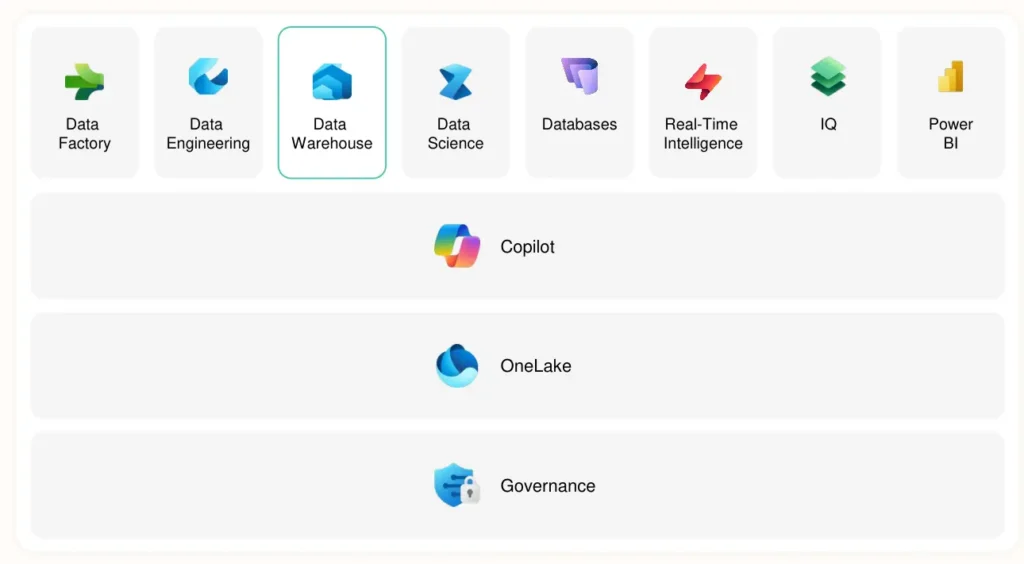
Implement Modern Enterprise Data Warehouse with Microsoft Fabric
Spargent Analytics designs, migrates, and optimizes Microsoft Fabric Data Warehouse environments to support governed SQL analytics, Power BI reporting, financial insights, and enterprise decision-making. We develop architectures for executive and board reporting, trusted metrics, enhanced security, and modernization.
Microsoft Fabric Data Warehouse provides a managed SQL layer for curated data, reliable models, and analytics-ready reporting. Spargent leverages Fabric for historical performance analysis, financial planning and reporting, and a performance-focused BI foundation across strategy, close, planning, operations, and Power BI.
Business Problems
What Business Problems Microsoft Fabric Data Warehouse Solves
›Finance, sales, and operations often report inconsistent revenue and margin figures.
›Leadership requires multi-year trend reporting across entities and locations.
›Budget-versus-actual reporting is slow and manual.
›Managers lack trust in departmental KPIs due to inconsistent definitions.
›The company needs board-ready reporting with auditability.
›SQL-based reporting is slow on raw or semi-structured datasets.
›Departments create isolated data marts that become inconsistent over time.
›Finance seeks a single source for close, forecast, and KPI reporting.
›Executives require fast drill-down from company to branch or product level.
›The company wants governed SQL analytics without the burden of infrastructure management.
Who Benefits
Who Benefits from Microsoft Fabric Data Warehouse
CFO or Director of BI
Gains consistent views of revenue, margin, close, forecast, and board reporting.
COO
Achieves greater operational visibility.
FP&A leaders
Improve planning cycles.
BI Managers, Controllers, CIOs & Data Platform Owners
Benefit from a governed warehouse model that enhances collaboration, security, and reuse.
Key Benefits
Key Business Benefits of Microsoft Fabric Data Warehouse
One trusted revenue and margin model
Standard historical trend dashboard
Automated variance reporting
One KPI definition source
Stable board-report dataset
Faster dashboard and ad hoc response
Fewer separate marts
Unified finance dataset
Executive-to-detail drill path
Rapid warehouse start
ROI Signals
ROI Signals That Show Microsoft Fabric Data Warehouse Is Delivering Results
Success is demonstrated by fewer metric disputes, faster close, improved planning and benchmark analysis, reduced reporting preparation time, faster review cycles, higher trust, less reconciliation effort, and lower reporting risk. Additional indicators include a better user experience, reduced wait times, lower maintenance, fewer contradictions, quicker close-to-report cycles, faster issue identification, and reduced administrative burden.
Why Move
Why Companies Move to Microsoft Fabric Data Warehouse
Establish a governed warehouse KPI layer with standard definitions to improve departmental scorecards and provide leaders with a high-performance big data platform for consistent measurement. Load curated historical data into a central warehouse to support board and lender reporting with auditable time, entity, branch, and product logic.
Organize curated financial and planning data for repeatable reporting and to enhance the finance data hub. Use the warehouse as the canonical metric layer to ensure revenue, margin, forecast, and KPI logic are shared. Store curated relational data in a governed reporting structure to support enterprise reporting consolidation.
Move business-ready tables into the warehouse to enable efficient querying and support a distributed data-processing cloud platform. Consolidate curated reporting into a central warehouse model to eliminate shadow marts. Use warehouse tables as the central, curated finance layer and model them to support cross-functional drill paths that enable leadership drill-down analytics. Leverage Fabric’s managed warehouse experience to refresh your modern BI platform.
Business & Technical Challenges
Technical Challenges Solved by Microsoft Fabric Data Warehouse
Limited lineage, inconsistent numbers, and hard-to-audit spreadsheets are replaced by auditable reporting. Raw data query overhead, poor indexing, and mixed data shapes are addressed with optimized SQL analytics. Shadow marts, duplicated logic, and maintenance overhead are reduced. Scattered finance extracts, inconsistent hierarchies, and duplicate calculations are consolidated into controlled finance tables. Disjoint reporting hierarchies and poorly conformed dimensions are improved with drill paths. Infrastructure overhead in legacy systems, scaling challenges, and platform fragmentation are addressed with managed Fabric.
Old pattern
Inconsistent KPIs
Inconsistent KPI logic, spreadsheet sprawl, and lack of a governed SQL layer.
Modern Fabric
Governed metric model
Resolved with a controlled metric model.
Old pattern
Slow SQL on raw data
Weak historical modeling, inconsistent marts, and poor query performance.
Modern Fabric
Curated, optimized warehouse
Addressed through a curated warehouse design.
Old pattern
Isolated data marts
Manual consolidation, version mismatches, and repeated SQL extracts.
Modern Fabric
Single source of truth
Replaced by automated movement into business-ready tables.
Old pattern
Manual consolidation
Metric fragmentation, uncontrolled local marts, and definition drift.
Modern Fabric
Automated, business-ready tables
Resolved through governed measurement.
Core Capabilities
Core Capabilities of Microsoft Fabric Data Warehouse
Spargent designs high-performance query processing patterns so the warehouse can serve as a high-throughput data analytics platform for dashboards and ad hoc analysis.
Simplified warehouse administration supports a next-generation cloud data platform roadmap, while separation of storage and compute improves enterprise big data storage and compute planning.
01
Enterprise-scale SQL analytics
Fabric supports enterprise-scale SQL analytics for curated facts, dimensions, snapshots, and repeatable management reporting within a big data analytics infrastructure.
Facts & dimensions
Snapshots
SQL endpoints
Aggregations
02
Unified storage with OneLake
Unified data storage with OneLake creates an enterprise cloud data platform across warehouse, lakehouse, engineering, and BI workloads.
OneLake
Lakehouse
Shortcuts
No data copies
03
Native Power BI integration
Native Power BI integration reduces data duplication and improves ownership.
Built-in governance and security support enterprise-grade big data management through roles, permissions, lineage, certification, and domains.
RBAC
Lineage
Purview
Certification
06
Centralized data management
Centralized data management enables Spargent to deliver efficient big data processing services using certified tables.
Certified tables
Domains
Storage/compute
Simplified admin
OneLake
How OneLake Enhances Enterprise Data Warehousing
OneLake centralizes enterprise data, eliminates duplication, supports cross-team access, simplifies governance, enables a single source of truth, and connects warehouse and analytics workloads. It also provides a scalable data lakehouse engine foundation across Fabric experiences.
Governance & Security
Enterprise Governance and Security in Microsoft Fabric Data Warehouse
Spargent configures role-based access control, data lineage and auditability, Microsoft Purview integration, compliance readiness, secure access, and centralized governance policies. These measures reduce reporting risk while preserving self-service analytics.
Comparison
Microsoft Fabric Data Warehouse vs Traditional Data Warehouse Platforms
Microsoft Fabric vs Snowflake
Snowflake is a robust cloud warehouse, while Fabric integrates with Power BI, OneLake, Purview, and Microsoft security strategies.
Microsoft Fabric vs Azure Synapse Analytics
Fabric offers a more unified SaaS analytics experience.
Microsoft Fabric vs Amazon Redshift
Redshift suits AWS-centric environments, while Fabric is ideal for Microsoft-focused teams.
Microsoft Fabric vs Google BigQuery
BigQuery excels on Google Cloud, while Fabric aligns with Microsoft BI.
Microsoft Fabric vs Traditional SQL Data Warehouses
Fabric reduces fragmentation across ingestion, storage, governance, modeling, and reporting.
Industries
Industries Using Microsoft Fabric Data Warehouse
Industries We Serve
Healthcare
Unifies finance, claims, capacity, and operations.
Retail and e-commerce
Analyze product, customer, inventory, channel, and margin.
Manufacturing
Connects production, quality, supply chain, sales, and finance.
Logistics and supply chain
Measure cost, route, carrier, capacity, and service.
Financial services
Governed profitability, risk, lender, and management reporting.
Technology and SaaS
Combine usage, revenue, support, success, and finance.
Governed warehouse, sector-ready
Industry-specific architecture for governed data, reporting, AI, and real-time operations.
Why Fabric
Benefits of Data Warehousing Inside Microsoft Fabric
Data warehousing within Fabric enables shared data across analytics workloads, native integration with Power BI, unified governance across the platform, faster collaboration between data teams, reduced platform fragmentation, accelerated time-to-insight, and consistent metrics across reporting and analytics. It also supports an advanced big data engineering platform for a single governed operating model.
Why Spargent
Why Choose Our Microsoft Fabric Data Warehouse Consulting Services
We transform reporting challenges into effective warehouse design, Power BI delivery, and mission-critical big data solutions.
Microsoft Fabric architecture
Enterprise data warehouse modernization
Legacy warehouse migration
Scalable data modeling and design
Performance optimization
Security and governance
End-to-end implementation and support
Long-term platform optimization
Implementation Process
Microsoft Fabric Data Warehouse Implementation Process
01
Current data platform assessment
02
Data warehouse architecture design
03
Data modeling and migration planning
04
Data integration and loading
05
Performance tuning and validation
06
Security and governance configuration
07
User enablement and training
>>
From Scope to Production
Each phase delivers a high-speed, practical, and governed cloud data warehouse.
A focused pilot can validate architecture; timing depends on complexity, scope, quality, and security.
Get Started
Schedule a Microsoft Fabric Data Warehouse Assessment
Evaluate your current data warehouse environment to identify risks, performance issues, governance gaps, and reporting challenges.
Our assessment provides a detailed gap analysis of your architecture and processes, a migration roadmap to Microsoft Fabric, an initial modernization cost estimate, a risk mitigation action plan, and executive-ready deliverables outlining recommended next steps. Identify modernization opportunities where Fabric can reduce manual work and improve trust. Build a Microsoft Fabric migration roadmap focused on value, feasibility, and adoption.
Consult with a Microsoft Fabric Data Warehouse expert to plan a governed, scalable analytics platform.
Ready to plan your Microsoft Fabric project?
Book a free expert session to discuss your current data platform, reporting needs, and implementation roadmap.